
The Hidden Cost of a Dull Blade on Your Poultry Line
Cutting performance is one of the most controllable variables in poultry processing — and one of the least monitored. Here's what the data tells us, and what leading operations are doing about it.
BY THE NUMBERS
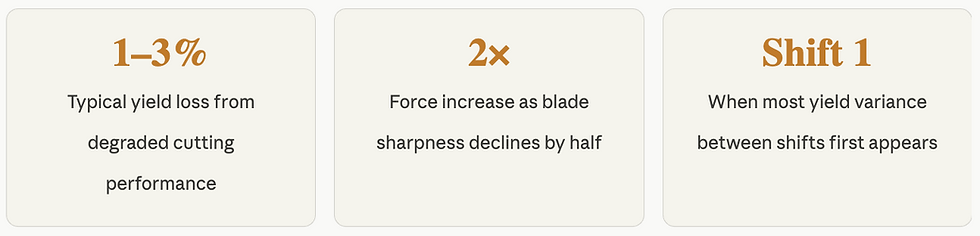
Why poultry demands more from every blade
Poultry processing operates at a speed and precision that leaves almost no margin for variability. From whole-bird breakdown through deboning and portioning, each cut affects not just the piece it produces — but every downstream step in the process. A fractionally inconsistent cut creates rework. Rework creates labor cost. Labor cost eats margin.
The challenge is that cutting performance doesn't fail catastrophically. It degrades gradually — shift by shift, hour by hour — and those incremental losses tend to go untracked until they show up as yield variance, QC flags, or operator fatigue reports.
HARVEST BLADE PERSPECTIVE
|
Where performance actually breaks down
Equipment failure is easy to diagnose. Gradual cutting degradation is not. The symptoms are subtle, spread across shifts, and rarely attributed to their root cause:
Operators applying more force — increasing ergonomic risk and fatigue
Slightly ragged cut surfaces requiring extra trimming at final inspection
Inconsistent portioning weights that widen across a shift as blades wear
More frequent line slowdowns to compensate for machine cutting resistance
Bone fragment risk increasing as blade geometry drifts from spec
Individually, these look like minor inefficiencies. At high line speeds — and across multiple shifts — they compound into meaningful yield loss, elevated labor cost, and preventable quality escapes.
“The goal isn’t just to keep the line running — it’s to keep it running predictably, shift after shift, at the same standard of cut.”
What high-performing operations do differently
The distinction between average and top-tier poultry processors often comes down to how systematically they manage cutting performance — not just whether blades are sharp, but how consistently blade performance is maintained across every shift and every station.
Leading operations tend to:
Set defined sharpening intervals based on throughput, not elapsed time or visible wear
Track yield variance by shift and correlate it back to cutting tool performance
Standardize blade specifications across stations to reduce cut-to-cut variability
Partner with a sharpening and distribution provider who understands food-grade tolerances
Use consistent blade sourcing to eliminate spec drift between replacement cycles
ON SHARPENING INTERVALS
|
The sharpening and distribution partnership
Harvest Blade works directly with poultry processors as both a professional sharpening service and an industrial blade distributor. That combination matters: when sharpening and sourcing come from the same partner, blade specifications stay consistent across the full cycle — from initial spec to re-sharpened tolerance, batch after batch.
We understand the sanitation requirements, the tolerances, and the line speed realities that make poultry processing uniquely demanding. Our job is to make sure your cutting performance isn’t the variable that costs you yield.
Seeing yield variability or inconsistency between shifts? We can help you take a closer look. Whether that means a sharpening program, sourcing the right new blades for your lines, or building a managed inventory system that keeps the right blades available at the right intervals — Harvest Blade handles the full cutting performance picture, so it's one less variable for your team to manage. Contact Harvest Blade to talk to a specialist → sales@harvestblade.com or (888) 946-9970. |